
Throughout the Media Audiences module I have learnt about various different media theories, each of which are exciting and thought-provoking. This blog post is going to focus on a few of the theories I have studied and how they can be applied to the findings from my media log. When thinking about these specific theories, it is easy to see how they fit into my everyday life despite not noticing them on a daily basis. I found it interesting to apply these theories to my usage of media, and throughout this process I've realised that there is much more to just interacting with media than meets the eye.
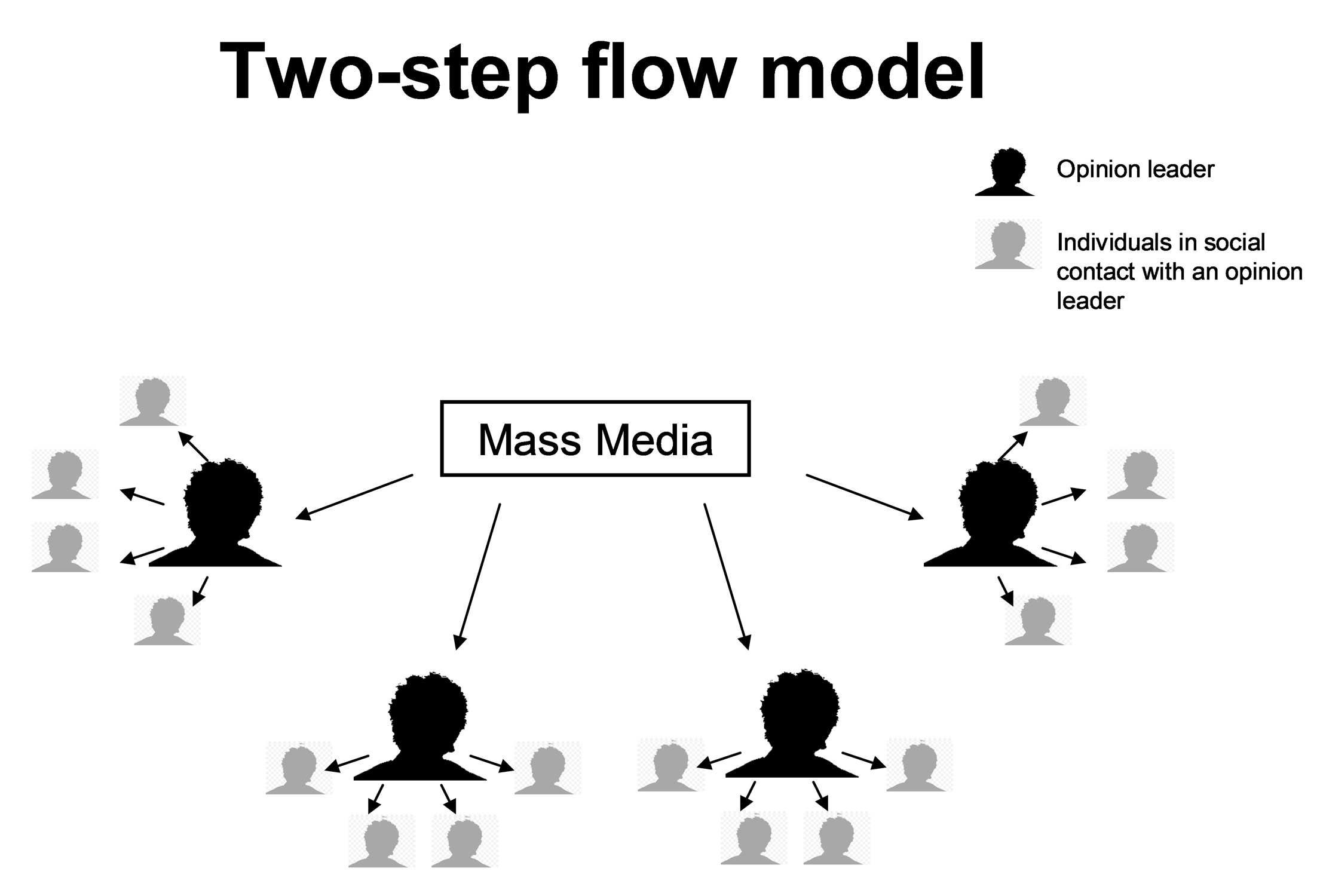
I found that I could see links between the Two-Step Flow Theory by Paul F. Larzasfeld and Elihu Katz (1955), and what I had noted down in my media log. The Two-Step Flow model talks about the significance of 'influential figures', and how these figures are known as 'opinion leaders'. Opinion leaders can be anyone who is deemed as 'trusted' by those in 'social contact' with them.

After
logging three days media usage, and studying this theory, it is evident to see
that there are opinion leaders who affect my behaviour. An example which comes
straight to my mind when I apply this theory to my everyday life is YouTubers
(vloggers) and bloggers. It's true that those with 'status' (aka those with a
large following), are able to have an influence on their followers. In this
case, the source (media) would be YouTube, the opinion leader would be the
vlogger and 'everyone else' and myself (e.g.) would be those who follow and
listen to what the opinion leader has to say.
This pattern has occurred often in my life, from watching YouTube from a young age. I have learnt to trust specific people on the internet, and their opinion becomes of importance to me. Therefore, if a vlogger I trust is to promote a product I am interested in buying, I am more likely to go out and buy the product as I value their opinions as both honest and reliable. This also makes me engage in more media as I am then using the internet more, search engines and popular websites looking at blogs or products that are mentioned in the videos I watch.
While this is most definitely a form of advertising, I have still logged watching YouTube and reading blogs as under the 'entertainment' bracket. This is for two reasons, 1) I watch both unsponsored and sponsored content on YouTube so it wouldn't always be classed as 'advertising', and 2) I have decided not to log advertisements in my media log as we are constantly surrounding by adverts and it would be way too complicated to log down every advertisement I see on a daily basis.


Copyright.
Moving
on from the Two-Step Flow theory, I discovered that the Uses and Gratifications
theory was very relevant when it came to the findings from my
media log. Whereas the Two-Step Flow Model of Communication is known as an
'effects theory' (in which most effects theories are condemned for
placing audiences as 'passive'), the Uses and Gratifications theory believes
audiences are active. The theory describes uses as how and why people use
media, and for what purpose; while it states that gratifications are the means
in which the media indulges our desires.
McQuail
(1969) talks about four different terms regarding the uses and gratifications
of the media*:
Surveillance - understanding and knowing what
is happening in the world/around us
Personal
Identity -
evolving and 'expressing' identity
Personal
Relationships -
the use in creating and maintaining relationships
Diversion - distraction, 'fantasy',
entertainment
*(Media
Audiences Lecture 6: Uses and Functions)
I
found that all four related to my media findings in some way or another, for
example reading the politics section on the BBC News application on my iPhone
meant 'surveillance'; wanting to learn and understand about what was taking
place in the world I live in.
Further,
social media websites such as Instagram, Twitter, Facebook and Snapchat all
fell under the 'personal identity' category as all my social media accounts on
these platforms express different sides of my personality. This is further seen
with my own blog, in which I have created a personal identity as a 'beauty and
lifestyle blogger'.
'Personal
relationships' were also found frequently within my media findings as I use
media to communicate with my loved ones. I am constantly replying to group
chats on Facebook Messenger, as well as messages from my boyfriend and family.
Media definitely helps to maintain relationships as it provides various
platforms of communication, and from my findings I know that I use these means
of communication everyday.
Finally,
'diversion', I find this applies to my life significantly well. Binge watching
television programmes works perfectly as a distraction from the 'real world',
whether its taking me away from doing university work or just general worries
in my everyday life (e.g. homesickness). I also find that 'diversion'
can be applied to scrolling through social media, watching YouTube videos and
even listening to music while going to the gym - as these are all forms of
escapism.
The
findings from my media log can also be linked to Katz et al's theories
concerning uses and gratifications (1973). Katz et al mentions 'social needs',
which is the need to contact others. This is specifically important to me while
living away from home at University as the need to keep in contact with my
family is very important to me. This is reflected in my media log, in which I
am constantly checking Facebook and Facebook Messenger to reply to messages
from people I no longer see everyday. Further Katz et al mention 'integrative
needs', in which media provides 'confidence, stability, status'**. This is
again seen throughout my media log, constantly checking up on my blog and how
it is doing regarding its popularity amongst the world of social media.
I would love to compare my findings from my
media log with my course mates, as its interesting to see in which ways they
use media and whether they are similar or different to myself. I feel I was
successful in completing the log, despite finding it difficult to log
every single time I went on social media. If I was to do another media log in
the future, I would like to do a longer one over seven days to compare my media
usage between weekdays and weekends.

No comments:
Post a Comment